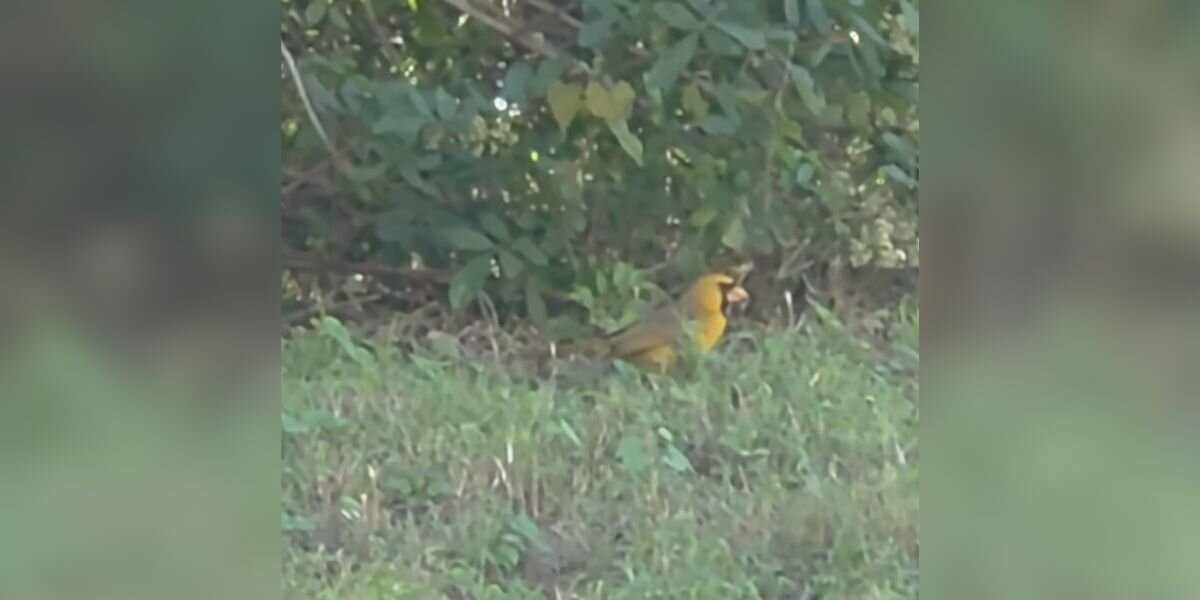

While tending her garden in Coral Springs, Florida, last October, nature lover Dyane Oliva noticed something unusual in the grass.
Out of the corner of her eye, she caught sight of what she described as a “little yellow blob.” At first, she assumed it was an oriole — the bright color would’ve made sense. But when she looked closer, the bird’s shape and markings told a very different story.
It looked like a cardinal.
That couldn’t be right, though. Cardinals are famous for their bold red feathers, not lemon-yellow ones.
“He had the little facemask that cardinals usually have,” Oliva told Miami New Times. “I thought, ‘There’s no way this is a cardinal — it’s yellow! It’s as bright as a lemon!’”
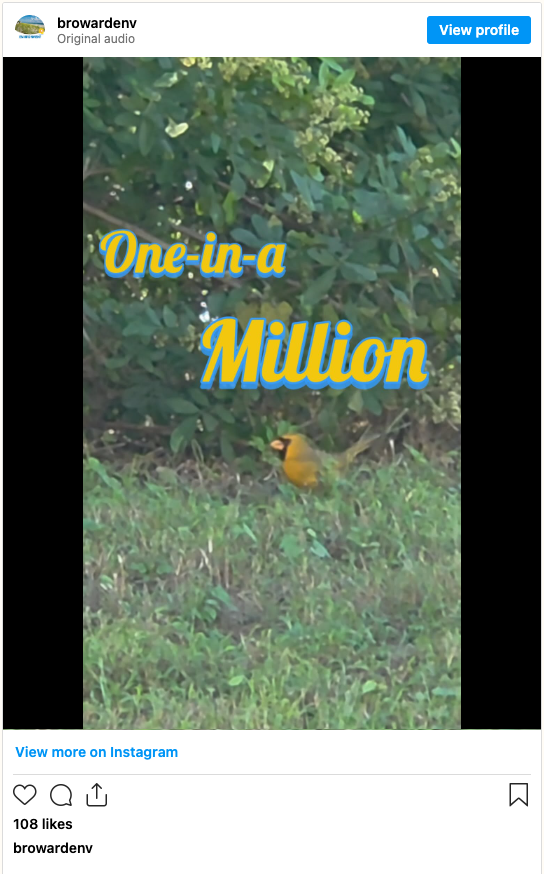
Oliva, who works for Broward County’s Natural Resources Division, immediately grabbed her phone and began recording photos and videos of the bird. She shared the sighting with colleagues, posted it online, and reported it to the Florida Ornithological Society.
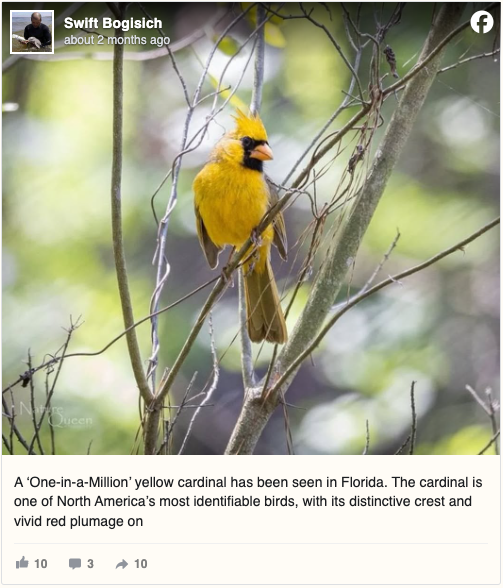
Experts later confirmed what Oliva had stumbled upon: a Northern cardinal with an extremely rare genetic mutation that causes its feathers to appear yellow instead of red — a phenomenon seen in roughly one out of every one million cardinals.
“Although not unheard of, it is a rare sighting,” José Francisco Barros, president of the Tropical Audubon Society, told Miami New Times. “There are only about three seen every year in the country, or within their range, which is mostly Eastern North America. Everyone knows the red cardinal, so seeing a yellow one is especially striking.”
For Oliva, the magical moment was more than just a lucky encounter — it was a reminder of how much wonder exists right outside our doors. She hopes her experience inspires others to slow down, look around, and give birdwatching a try, especially during Florida’s busy migration season.
“This is definitely the time to get out and try it,” Oliva said in a video for Broward County’s Natural Resources Division. “You can bird anywhere — your backyard, parks, even cemeteries. Anywhere there are trees and public land, you can just watch for a little while, and you’re almost guaranteed to see something amazing.”
Sometimes, all it takes is noticing a strange yellow blur to uncover a once-in-a-lifetime surprise.