
When you think of breathtaking insects, you probably picture the bright orange wings of the Monarch butterfly or the soft green glow of the Luna moth drifting through the night.

But deep in the forests of East, Southeast, and South Asia, there’s a moth that took a very different approach to survival.
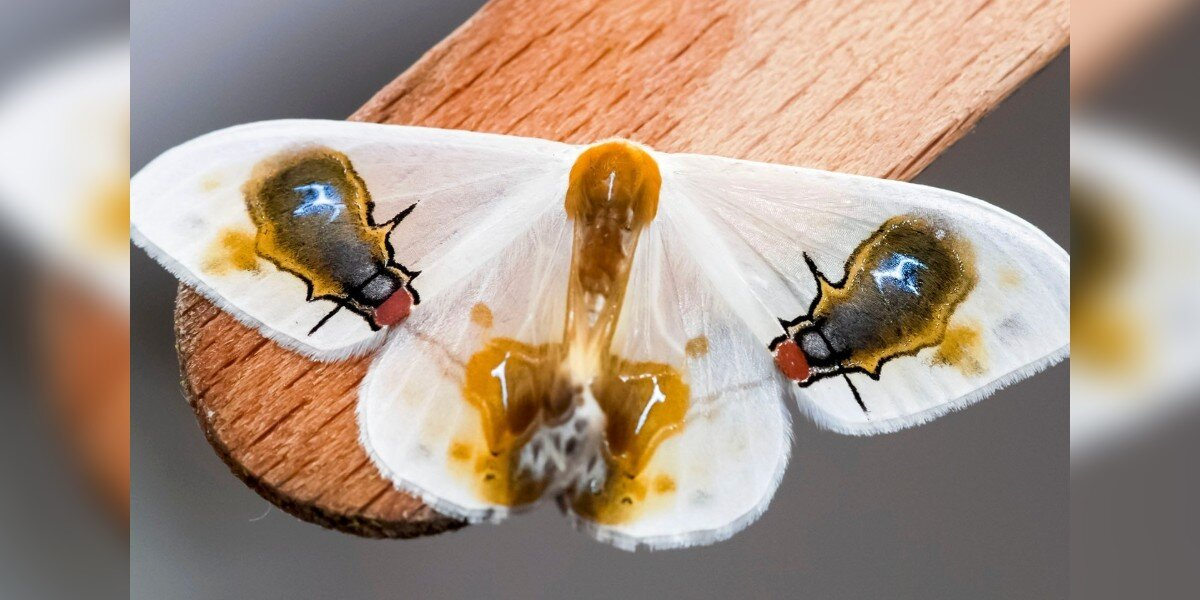
Meet Macrocilix maia — a master of disguise who has no interest in being beautiful.
At first glance, its wings look blotchy and odd — splashed with white, brown, yellow, and red. Nothing especially graceful. But look closer. Then look again.
What you’re actually seeing is something far more bizarre.
The markings on its wings create an incredibly detailed illusion: two flies hovering over bird droppings.

Yes. That’s the disguise.
And astonishingly, it works.
Predators scanning the forest for a tasty snack don’t see a moth at all. They see something unappetizing — something not worth the effort. Instead of becoming dinner, the moth is dismissed as waste and left alone.
“This incredible illusion doesn’t just look amusing; it’s a survival superpower, tricking predators into overlooking a perfectly edible moth,” shared The Untamed Paths on Instagram.
The resemblance is so convincing that when photos of the moth are placed next to real flies, it’s almost impossible to tell the difference at a quick glance.

And just when you think the deception couldn’t go any further — it does.
According to posts from the American Museum of Natural History, there are even reports that the moth may emit an unpleasant odor to enhance the illusion. It doesn’t just look like something foul. It may even smell like it.

Nature, it seems, committed fully to the bit.
When images of the moth began circulating online, reactions ranged from awe to disbelief.
“This is actually insane,” one commenter wrote. “How does nature even know what a fly looks like?”
The answer, of course, isn’t conscious design. It’s evolution.
Over millions of years, tiny genetic variations helped certain moths survive just a little longer than others. The ones whose wings most closely resembled something predators avoided were the ones who lived to reproduce. Generation after generation, that illusion became sharper, more convincing — until the moth we see today emerged.

While Macrocilix maia may not have the delicate elegance of a luna moth or the bold beauty of a monarch, it represents something just as extraordinary: ingenuity shaped by time.
In a world where standing out can get you eaten, sometimes the greatest beauty is knowing how to disappear.