
When people picture Snowy owl, they usually imagine endless Arctic tundra — not skyscrapers and city traffic.
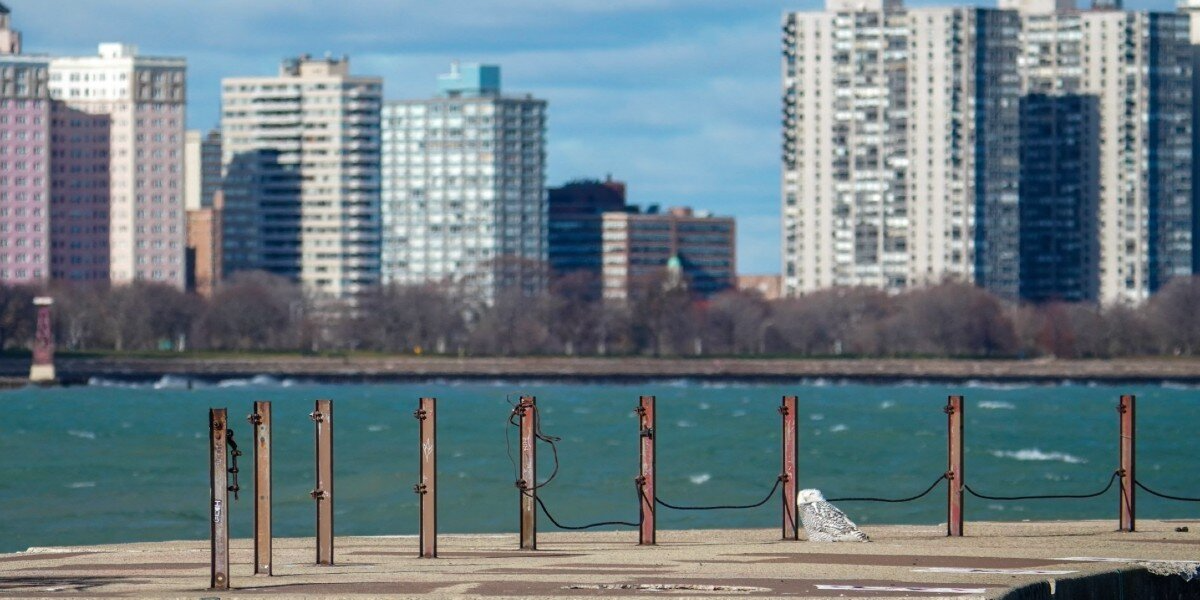
So when two of these striking white birds appeared along a pier in Chicago last month, locals could hardly believe their eyes.
Among those eager to catch a glimpse was Elena, an amateur birdwatcher who had long dreamed of seeing a snowy owl in person. As soon as she heard reports that a male and female had been spotted near the waterfront, she grabbed her camera and headed out on Thanksgiving Day.

It didn’t take long.
Soon after arriving, Elena saw the female perched quietly beside a fence post. Her feathers were puffed up against the cold, her eyes gently closing as if she were perfectly at peace — despite the urban buzz surrounding her.

“I was so excited to see this beautiful snowy owl,” Elena said.
Keeping a respectful distance, Elena simply stood and admired the rare visitor. Female snowy owls are typically larger than males and tend to have heavier dark markings across their white feathers. Against the steel-gray backdrop of the pier and skyline, her plumage looked almost unreal.
“These birds have a striking presence with their white plumage peppered with black feathers and piercing yellow eyes,” Elena said.

After braving the freezing wind to capture a few photos and videos, Elena headed home to warm up. When she shared the footage online, thousands of people were stunned by the sight: an Arctic predator calmly resting in front of one of America’s largest cities.
But as unusual as it seems, the owls’ visit isn’t entirely random.
According to Project SNOWstorm, snowy owls migrate south during the winter months. And every few years, something even more dramatic happens — an “irruption.”

An irruption occurs when food sources in the Arctic, especially lemmings, are abundant during the summer. A strong food supply leads to a highly successful breeding season, producing more young owls than usual. When winter arrives, many of these healthy juveniles head farther south in search of territory.
“This is caused by a surplus of snowy owl food, lemmings, this past summer and therefore a highly successful breeding season,” Elena explained.
While irruptions may feel extraordinary, they’ve been documented since the 1800s — long before modern climate concerns.
“[I]rruptions have been recorded since the 1800s, meaning they are not caused by climate change,” Elena noted. “However, climate change is definitely affecting these owls’ Arctic habitats and their food sources in concerning ways.”

By spring, the young female owl will likely return north to the tundra she calls home. The Chicago skyline will fade behind her as she journeys back to open Arctic skies.
But for Elena, the memory will stay.
“I have loved owls since childhood,” she said. “Seeing such an incredible species of owl for the first time in a city that is so meaningful to me was truly memorable.”
For a brief moment, winter in Chicago felt a little more like the Arctic — and a lot more magical.