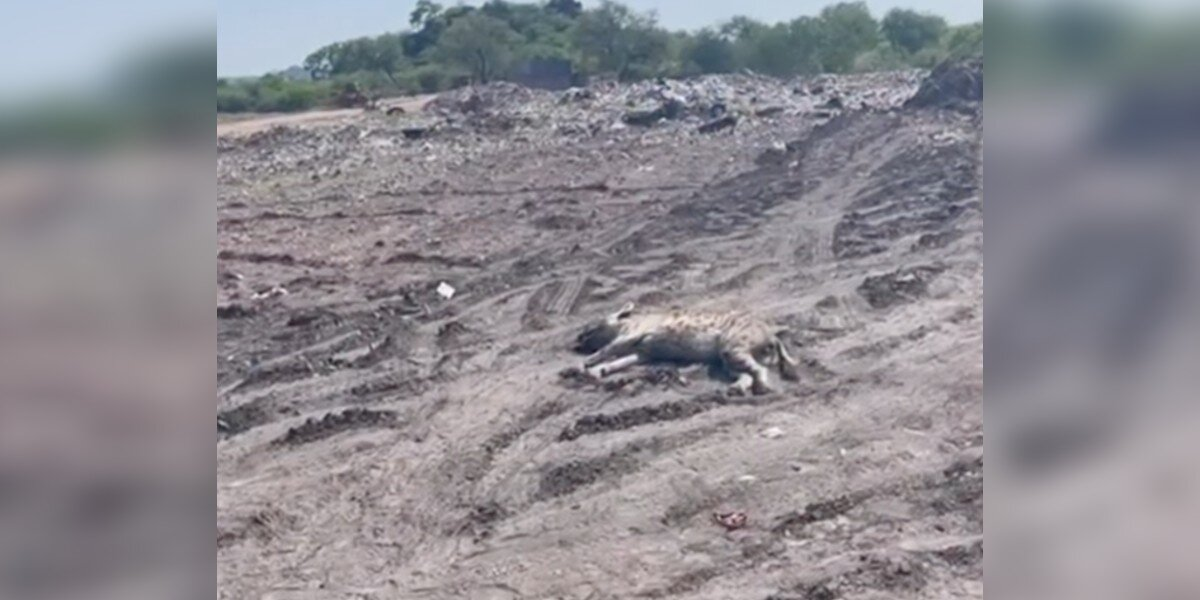

Workers arriving at a landfill in South Africa last month expected an ordinary morning.
Instead, they found a wild predator lying motionless in the dirt.

Sprawled in the open, baking under the unforgiving sun, was a spotted hyena — barely breathing.
The shocked employees immediately contacted the Limpopo Department of Economic Development, Environment and Tourism (LEDET), who alerted the Phalaborwa Natural Heritage Foundation (PNHF). Within minutes, volunteers and a veterinarian were racing to the scene.
What they found was dire.
“The hyena was lying in the open, in full sun and breathing rapidly,” said Eugene Troskie, managing director at PNHF. “[He] was already in a comatose state.”
A wire snare was tightened around the animal’s neck. He was unconscious — but still alive.
That faint breath was all the team needed to begin fighting for him.

For safety, the veterinarian sedated the hyena before moving him into the shade and onto a truck. Then came the next terrifying discovery: his body temperature had soared to 107 degrees Fahrenheit.
He was overheating fast.
Ice packs were pressed against his legs and paws. Every 15 minutes, volunteers drenched him in cold water. Gallon after gallon soaked his fur, pooling beneath him in the truck bed.

Still, there was little response.
“We were all doubtful about the animal’s recovery,” Troskie admitted. “He didn’t even show signs of having a blinking reflex when touching his eyes.”
The veterinarian suspected poisoning, possibly combined with the stress of the snare and the relentless heat. Medications were administered. Fluids were given. The team refused to stop.

Over the course of the day, more than 15 gallons of water were poured over the hyena’s body in an effort to cool him and coax him back from the brink.

Then, around 6 p.m., something incredible happened.
His eyes opened.
Hours later, to the team’s disbelief, the hyena slowly rose to his feet. Wobbly and unsure, he looked around as if trying to piece together where he was.

They continued monitoring him through the night. Finally, around 1 a.m. — nearly 20 hours after the rescue began — the team made a decision.
They opened the cage door.
“We didn’t want to keep him in the cage any longer than necessary,” Troskie explained, noting that hyenas often injure themselves trying to chew through confinement.
The hyena cautiously stepped forward. He sniffed the air, paused for a moment — then trotted off into the darkness, disappearing into the trees.

And just like that, he was gone.
The team hasn’t seen him since — which, in this case, is exactly what they hoped for. They believe he likely reunited with his clan and is continuing his recovery in the wild where he belongs.
For the volunteers at PNHF, the memory of that day remains unforgettable — a reminder of how fragile life can be, and how powerful persistence is.
What began as a seemingly hopeless scene in a landfill ended with a wild animal reclaiming his freedom.
The Phalaborwa Natural Heritage Foundation is an all-volunteer nonprofit organization. Its anti-poaching, research and snare removal work is crucial to conservation efforts in South Africa. To support this work, you can donate here.