
A few weeks ago in a forested area of New Jersey, a peaceful walk turned disastrous for one member of a roaming deer herd. A river cuts through the woods inside a long concrete ravine, its steep cement walls designed to control flooding. Somehow — either startled or slipping on the edge — one deer fell into the ravine and couldn’t climb back out.

Injured and stranded, the deer was trapped by walls rising 7 to 10 feet high that stretched for miles in both directions. With no exit in sight, all he could do was wait.
For nearly two weeks, he remained stuck as nearby residents looked on, growing increasingly concerned. Eventually, animal control was called, but officers quickly realized the rescue was beyond their capabilities. That’s when they reached out to Nancy Warner, founder and president of The Last Resort Wildlife Refuge.
“We walked two miles in each direction and couldn’t find any place where he could get out,” Warner told The Dodo. “That’s when we knew — he’d have to climb.”

Time was running out. Storms were forecast within 48 hours, and rising water would make the situation far more dangerous.
Adding to the heartbreak, the deer’s herd never left him behind.
“They stayed nearby the whole time,” Warner said. “They came to the wall to visit him, calling back and forth. It was really emotional to watch.”
The ideal solution — sedating the deer and lifting him out — was ruled out after USDA officials assessed the scene and determined it wasn’t safe. And since The Last Resort Wildlife Refuge isn’t authorized to sedate deer, Warner knew she had to find another way.

So she turned to creativity — and carpentry.
Warner called on Sandy Platt Mantione, a volunteer and skilled carpenter, and asked if she could build a set of stairs strong and stable enough for a deer to climb.
“She didn’t hesitate,” Warner said.

With storms looming and daylight fading, volunteers loaded wood and tools onto a trailer and carefully lowered everything into the ravine. Remarkably, the deer stayed calm throughout the process.
“He wasn’t panicked,” Warner said. “It felt like he understood we were there to help. He watched the entire time.”

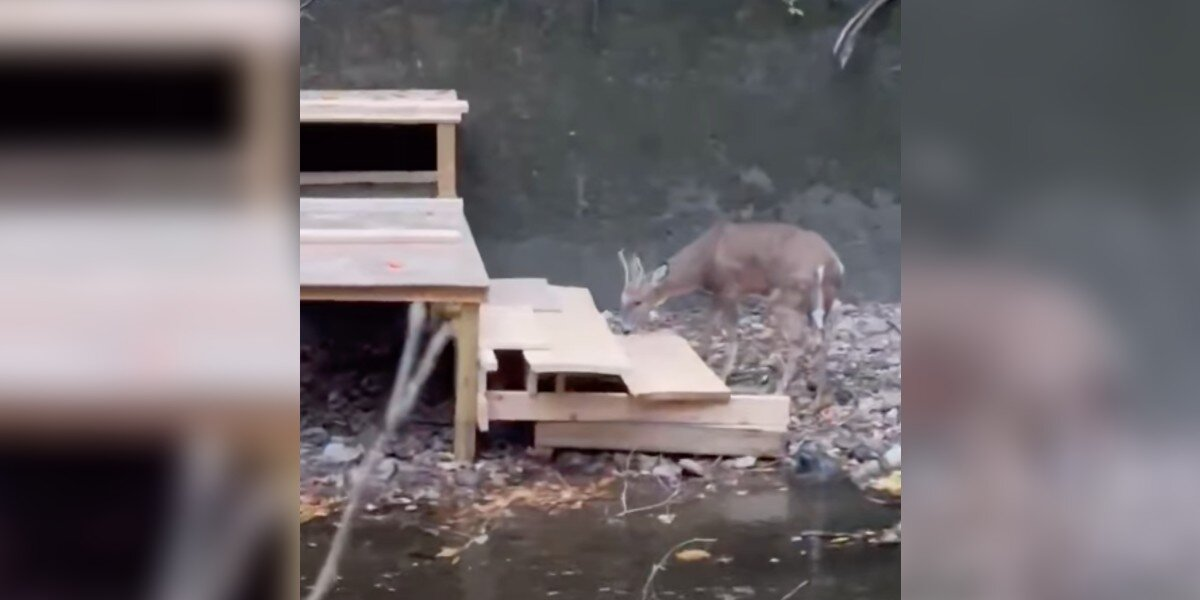
As Warner guided the design, Mantione and other volunteers from Associated Humane Societies Newark worked together to construct a custom staircase. It had to be wide enough for all four hooves and shallow enough to accommodate the deer’s injury.

“I had them add trim in certain spots so he could push off with his back legs,” Warner explained.
After nearly three hours, the staircase was finished. The team placed food pellets along the steps, quietly gathered their tools and backed away.
Moments later, the deer approached his new escape route. After sniffing the food, he stepped onto the stairs — and within 15 minutes, he climbed all the way up and out of the ravine.

Free at last, he disappeared into the woods, rejoining his waiting herd.

Warner later confirmed the deer had suffered only a minor soft tissue injury, which has likely healed by now.
Reflecting on the rescue, Warner admitted she didn’t know if the plan would work.
“But,” she said, “we had to try.”
To support future rescues like this one, you can donate to The Last Resort Wildlife Refuge through their website.